

Main
News
Chinese Teacher Chen Wen: Why I Chose OshSU
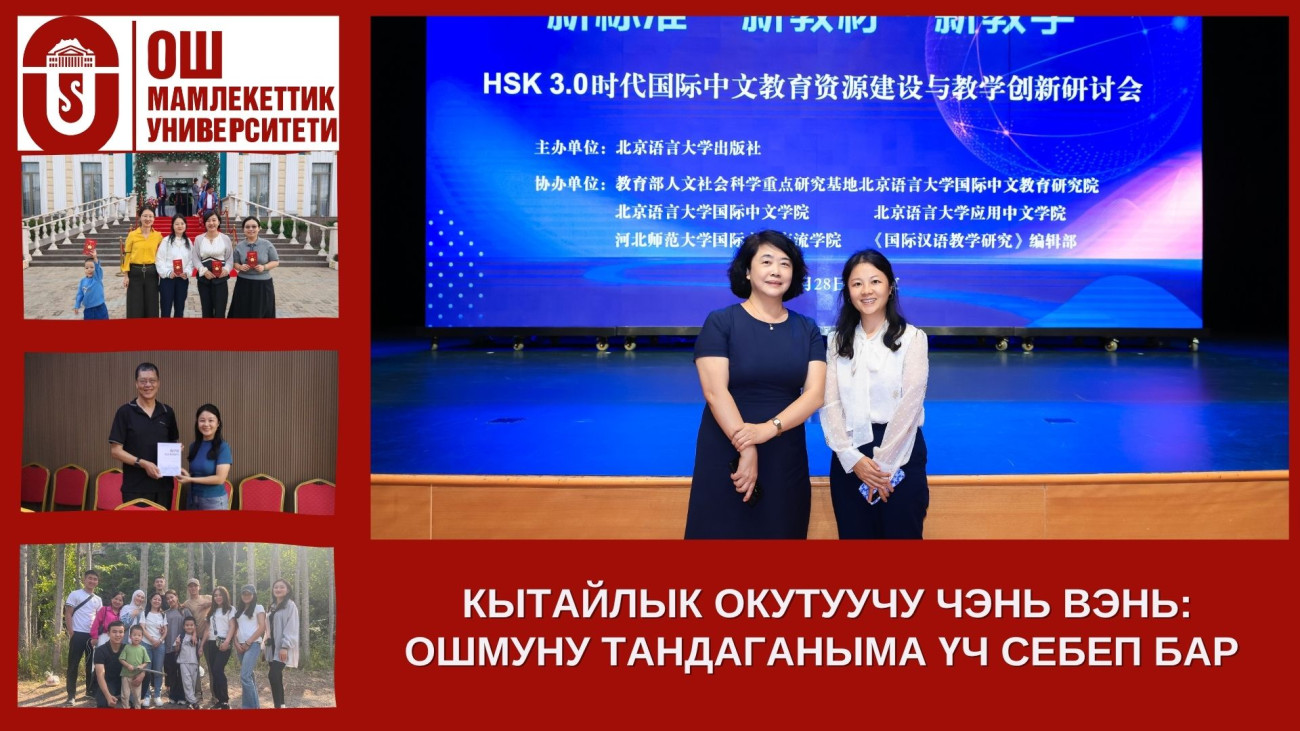
Learning a language opens the door to understanding another culture and discovering new opportunities. In recent years, interest in learning Chinese has also been growing among young people in Kyrgyzstan.
Chen Wen, a teacher at the Confucius Institute of Osh State University (Kyrgyz-Chinese Faculty), has been contributing to students’ language learning and professional development. He has worked in Central Asia for more than ten years. Since 2023, he has been teaching Chinese at the institute while also preparing students for creative competitions, developing teaching materials, and strengthening intercultural ties.
We spoke with Chen Wen about his decision to come to Kyrgyzstan, the teaching environment at OshSU, and his future plans.
— Hello! First, could you introduce yourself to our readers?
— I am from the Xinjiang region of China, and I am 39 years old. I graduated from Xinjiang Normal University.
— What motivated you to come to Kyrgyzstan, particularly Osh, and work at OshSU’s Confucius Institute?
— Before joining the Confucius Institute at Osh State University, I worked for six years at the Confucius Institute of Tajik National University. During a staff rotation, I was given the opportunity to choose which Confucius Institute to work at. Instead of choosing an institution in the capital, I chose the one at OshSU.
There were three reasons for my decision. First, OshSU’s Confucius Institute has its own academic building, dormitory, and campus. Its learning facilities and operational model differ from those of other institutes. I wanted to come here and gain new experience.
Second, during my six years in Tajikistan, I mainly taught Chinese at beginner and elementary levels. I had very few opportunities to teach undergraduate students. At OshSU’s Confucius Institute, particular attention is paid to teaching Chinese to undergraduate students. This offered me a valuable opportunity to broaden my professional experience and develop my teaching skills.
Third, I had heard that people in Osh were simple, kind, warm-hearted, and welcoming toward Chinese citizens. I wanted to live and work here and experience the hospitality of the local people firsthand.
— Do you remember your first visit to Kyrgyzstan?
— I first arrived in Kyrgyzstan, specifically in Osh, on February 28, 2023. Since I had already worked in Central Asia for a long time and spoke Russian well, the local food, lifestyle, and everyday customs did not feel entirely unfamiliar to me. I therefore did not feel like a stranger in a foreign place.
I tried local dishes on the very day I arrived. Their flavors were distinctive. I had not encountered many of these dishes while working in Tajikistan.
However, the greatest warmth came from my students and colleagues. When I first arrived in Osh, I did not know many things. My student Dawei voluntarily helped me with tasks such as obtaining a visa, undergoing a medical examination, and buying everyday necessities. He accompanied me wherever I needed to go. He is a student who respects his teacher and treats people sincerely.
My Chinese and Kyrgyz colleagues at the Confucius Institute also supported me in many ways. The Chinese teachers helped me settle in and deal with food, clothing, and housing, while my Kyrgyz colleagues welcomed me by car and helped me move. The way staff from the two countries support one another and work in harmony made the institute feel like one big family.
— What has your experience of working and interacting with students been like?
— I currently teach Chinese to undergraduate students at the Confucius Institute. I focus on strengthening their foundational language skills and developing their professional competencies. I also help organize academic activities, monitor students’ progress, and provide guidance.
The honesty of Kyrgyz students and their enthusiasm for learning have particularly impressed me. They participate actively in lessons and complete assignments carefully. Even after class, they come to ask questions about things they have not understood and try to deepen their knowledge.
They are open, modest, and polite. They respect their teachers, help one another, and maintain friendly relationships. Interacting with students every day allows me to feel their energy and desire to learn new things. At the same time, intercultural communication is enriching my own professional experience.

— Do your students help you learn Kyrgyz and become familiar with local culture?
— Through close interaction with students, many of my previous perceptions of Kyrgyzstan have changed. At first, I thought that because Tajikistan and Kyrgyzstan are neighboring Central Asian countries, their cultures and traditions would not differ very much. However, living here has helped me understand that there are significant differences between the national traditions and regional cultures of the two countries.
I have been particularly impressed by Kyrgyz traditions and performing arts. I enjoy dancing. While working in Tajikistan, I also learned some traditional Tajik dances. Kyrgyz traditional dances, however, have their own distinctive styles and characteristics.
Some aspects of local culture were entirely new to me. For example, I found it especially interesting that men wear the traditional kalpak hat and that men and women recite the epic Manas together.
One event that has stayed in my memory was a creative performance prepared by fourth-year students for Nooruz, based on the Manas epic. The program combined narration, stage performances, traditional songs, and national dances. It was rich in content and diverse in form, and the students presented Kyrgyz culture from many different perspectives. Their performance deeply impressed me. As a teacher, I felt genuinely proud of my students.

— What do you think is the main reason young people in Kyrgyzstan are interested in learning Chinese?
— In my opinion, employment opportunities and professional development are the main factors motivating young people to learn Chinese.
In 2023, following the pandemic, trade and economic cooperation and joint projects between Kyrgyzstan and China began to gain momentum. Many Chinese companies and joint projects are now operating in Kyrgyzstan. As cooperation between the two countries develops in transportation, the economy, and international relations, demand for specialists who speak Chinese is increasing.
People who have a good command of Chinese and professional qualifications have more employment options and better opportunities for career advancement.
This trend can also be seen in the Confucius Institute’s admission figures. In 2025, 200 students were admitted to the first year, while in 2026 the number reached 300. This shows that interest in learning Chinese is growing in Kyrgyzstan.
Of course, some students are also motivated by their interest in Chinese language and culture. By learning Chinese, they hope to visit China, learn more about the country firsthand, and perhaps pursue their education there.
— What advice would you give students who are just beginning to learn Chinese?
— I have worked in international Chinese-language education for more than ten years. I believe the “20/80 rule” is important in language learning. At the initial stage, establishing a solid foundation, developing good habits, and mastering effective methods directly influence future learning outcomes.
First, students should build a strong foundation in pronunciation and pay particular attention to tones. Tones are one of the defining features of Chinese. At the beginning, it is essential to devote sufficient time to practicing pinyin and tones. Even if you have to speak more slowly, try to master the pronunciation and tone of every word correctly. If you develop accurate pronunciation habits from the start, learning will become much easier later. Conversely, once incorrect pronunciation habits become established, correcting them can be quite difficult.
Second, students should develop their Chinese character-writing skills from the beginning. Writing is important for students specializing in Chinese. If you avoid writing characters at the initial stage, you may encounter difficulties mastering them later.
Third, you should establish a habit of studying regularly outside the classroom. Whatever language you learn, extensive reading and immersion in the language environment are important. Consistency and daily practice are equally essential when learning Chinese.
— What do you think of the teaching conditions and educational environment at OshSU’s Confucius Institute?
— I am very satisfied with the teaching conditions and educational environment at the institute. Compared with many Confucius Institutes in China, OshSU’s Confucius Institute has several distinctive advantages. It has its own academic building, dormitory, and dedicated campus. The classrooms are spacious, bright, clean, and comfortable. There is sufficient teaching equipment, and all the necessary conditions for education are in place.
— Which qualities of the local people do you appreciate most?
— I particularly appreciate the modesty, sincerity, and hospitality of the local people.
As part of the Confucius Institute’s activities, we frequently visit our students’ homes. Their parents always welcome us warmly and treat us as honored guests. Even when we contact them in advance and say that there is no need to prepare anything special or go to any trouble, they still lay out a generous table with fruit and drinks.
Some families involved in agriculture and livestock farming even slaughter an animal they have raised and prepare a special meal for us. Such simple, genuine, and heartfelt hospitality brings us a special sense of warmth every time we visit a family.
— What interests do you pursue outside teaching?
— I enjoy singing in my free time. Because of this interest, I voluntarily took the initiative to organize special Chinese-song classes at the institute. Every week, I teach Chinese songs for two academic hours.
Through music, I try to promote Chinese culture and increase students’ interest in learning the language. Under my guidance, students actively participate in Chinese-language creative competitions and achieve good results. They have also won top places in the national Chinese singing competition organized by the Confucius Institute.
— In what other areas could cooperation between universities in Kyrgyzstan and China be developed?
— A certain system for training students has already been established through cooperation between universities in Kyrgyzstan and China. One important area is joint educational programs between universities in the two countries.
Through these programs, students can apply for government scholarships and study under a “two years in Kyrgyzstan, two years in China” model. This allows them to strengthen their language skills and cultural knowledge in their home country while also receiving professional education in China. As a result, their academic level improves and their horizons broaden.
Furthermore, as strategic cooperation between the two countries deepens, links between higher education institutions are also expanding. Both sides are working together on Chinese-language teaching, scientific research, textbook development, joint teacher training, and cultural cooperation.
In the future, cooperation could be expanded further by increasing opportunities to study in China, establishing targeted support programs, and creating employment opportunities through partnerships between universities and businesses. This would open up new pathways for young people in Kyrgyzstan.
— What are your goals and plans for the future?
— Over more than ten years of working in international Chinese-language education in Central Asia, I have gained extensive practical experience in teaching, research, and competition participation.
In 2025, I won first place in a national competition for Chinese-language teachers’ teaching skills held in Kyrgyzstan.
While working at OshSU’s Confucius Institute, under the leadership of An Deyuan, the Chinese director, I actively participated in developing Chinese-language textbooks for undergraduate students. Among other projects, I served as chief editor of a locally adapted textbook titled Course in Official Document Writing.
In addition, under An Deyuan’s leadership, our team submitted a project about the distinctive development model of OshSU’s Confucius Institute for an educational achievement award at Xinjiang Normal University. In 2026, the project received a special university-level award.
In the future, I would like to use the experience I have gained in Chinese-language education in Central Asia to help develop the education sector. Through sharing experience, providing methodological guidance, and conducting joint research and methodological work, I aim to support the professional development of Chinese-language teachers in Kyrgyzstan.
My main goal is to promote culture through education.
— You are working in Kyrgyzstan. You must miss your homeland. What keepsake would you like to take back to China from here?
— Having worked abroad for a long time, I especially miss the traditional and regional dishes from different parts of China.
Kyrgyzstan, however, has given me many precious memories. Kyrgyz students have remarkable creativity and imagination. Their handicrafts, drawings, embroidered items, and uniquely designed diaries and memory books are very beautiful.
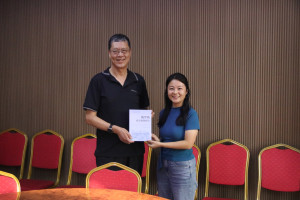
When I return to China, I would like to take a memory book made by my students themselves. It would be especially valuable to me if it included their drawings, embroidered decorations, photographs from everyday life, and heartfelt wishes.
— Which places would you recommend to a friend or acquaintance visiting Kyrgyzstan from China for the first time?
— First of all, I would recommend Issyk-Kul. Its natural scenery is incredibly beautiful, its water is clear, and the surroundings are peaceful. It offers a wonderful opportunity to experience the beauty of Asian nature.
Next, I would invite them to visit Sulaiman-Too in Osh. This place has great historical and spiritual significance for local people. Its historical and cultural heritage is profound, and the surroundings leave a special impression.
I would also recommend the Kara-Koy area in Osh Region. Its beautiful natural scenery, mountains, rivers, and pleasant environment offer a wonderful opportunity to relax and become better acquainted with Kyrgyzstan’s natural beauty.
— What would you like to say to the students?
— Studying in China is not the only goal of learning Chinese. The most important thing is to take your studies seriously, master Chinese well, and strengthen your professional knowledge.
Value your student years. Work hard, persevere, and keep moving forward. With a strong command of Chinese, you can gain access to good employment opportunities and take steps toward building a bright future for yourselves.
Interview by Zinagul Nuralieva
Photogallery




Main Campus of OshSU, 331 Alymbek datka Street, Osh City, Kyrgyzstan. General Division: +996 3222 7-07-12, fax: +996 3222 7-09-15, edu@oshsu.kg
OshSU Admissions Committee: +996 3222 7-08-18, priem@oshsu.kgColleges
- International Education Programs
- Medical College
- Finance and Law
- Uzgen International Medicine
- STEM Innovation
- Industrial and Pedagogical
- College of Agriculture
- Construction College
Schools
- "Arashan" Humanitarian School
- Institute of Oriental Studies
- Institute of Mathematics, Physics, Engineering and Information Technologies
- Institute of Economy, Business and Management
- Institute of Philology and Intercultural Communication
- Institute of History and Law
- Institute of Pedagogy, Art and Journalism
- Institute of Natural Sciences, Physical Education, Tourism and Agrarian Technologies
- Institute of Nanotechnology and Artificial Intelligence
Lyceums and gymnasiums
Offices
- Administrative- household supporting office
- Business Park at Osh State University
- International Relations Department
- Department of Academic Affairs and Strategic Planning for Educational Policy Development
Centers
- Cultural and Aesthetic Center named after R. Adikadyrov
- Foundation of R.Abdykadyrov
- Public Relations Center
- Internship and Career Center
- OshSU Center for Qualification Improvement
- Next Generation Hub Center
- Congress Resort OshSu Center
- Natural Resources Center
- Mountain Ecosystem Protection and Green Innovations Consulting Center
- Center for Scientific Research and Innovation


