
Main
News
Nursultan Kubanychbek uulu: Archives are living history

A boy from Ak-Bulak village in the Nookat district, who once dreamed of becoming a shepherd, is today a scholar studying 19th-century socio-political processes through archival sources. Historian, educator, and education sector leader Nursultan Kubanychbek uulu shares in this interview his childhood dreams, student leadership, experience as a director, challenging days in the Tashkent archives, and his true goals on the path of science.
– Before starting the interview, could you tell us who Nursultan is, what his childhood dreams were, and what kind of character he had?
– I was born in 1994 in Ak-Bulak village, which belongs to the Kyrgyz-Ata rural municipality of the Nookat district. My childhood was carefree and full of dreams. I remember once hearing a story about Adam and Eve, after which my older brother and I tried to make a human figure out of clay and breathe life into it by blowing into its nose (laughs). When my brother finally said, “It doesn’t work,” I was very upset. At one point, our family kept sheep, and I used to herd them. During those years, when our homeroom teacher Jumagul asked, “Who do you want to become in the future?”, I wrote that I wanted to be a shepherd. I am the youngest in the family. I grew up spoiled, and even now some signs of that remain. However, I was a responsible child who listened to advice.
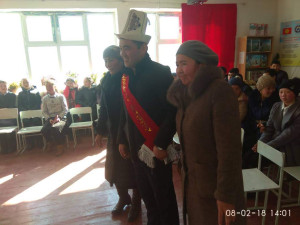
(In the photo with my homeroom teacher)
– Who influenced your choice to study history?
– My grandmother used to tell stories about past events and the life they had lived in a very engaging way. In our family, there were often conversations about social life and history. All of this probably encouraged my interest in history. My school teachers also played an important role. I was taught by excellent history teachers such as Kubanych Baimurzaev and Aisalkyn Maksytova. They regularly took us to history and social studies olympiads. Especially Aisalkyn teacher inspired me more, motivating a skinny boy who used to herd sheep to pursue education and develop an interest in history. When graduating from school, I chose history as an additional subject for the National Scholarship Test, and the results were good. The final decision was made by my eldest brother, who personally brought me to Osh State University and helped me apply to the Faculty of History.
– Did your early career begin as the Student Ombudsman at Osh State University?
– In my third year, I was elected chairman of the Youth Committee of the Faculty of History and became actively involved in the student self-governance system. A year later, elections were held for the Student Ombudsman and the Youth Committee of Osh State University. At that time, elections to these student structures were highly competitive. Accordingly, social, cultural, and mass events among young people were held at a very high level. As a result, I was elected Student Ombudsman of the university by a majority vote. This position opened up great opportunities for me in gaining valuable life experience.
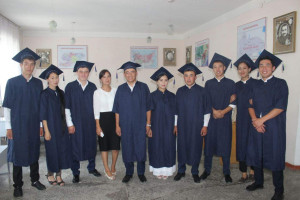
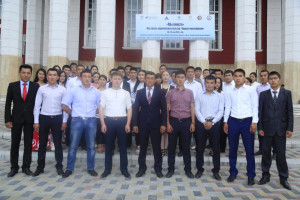
– In your professional career, managing educational institutions at Osh State University has played a major role. How did your path from teaching to becoming a director begin?
– My teaching career began in 2016 at the “Bilim” Lyceum of Osh State University. After working there for a year as a history teacher, Director Joogazyn Bolusheva appointed me as head of the academic department. Honestly, I had little pedagogical experience at the time, but Joogazyn teacher personally guided me and taught me many aspects of running a school. A year later, the then-rector, Kanybek Isakov, planned to open gymnasiums in the districts. He said, “Soon we will open gymnasiums in the districts; consider candidates for director positions among Bilim’s teachers.” Joogazyn teacher and Vice-Rector Tashbolot, who supervised schools, told the rector, “Nursultan is ready, you can appoint him.” Thus, I was appointed director of the gymnasium opened in Kara-Suu. I applied the experience I gained at the Bilim Lyceum and organized the educational process within this system.
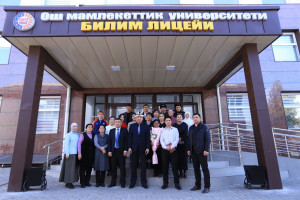

– What were the most important principles while you were serving as a school director?
– Honestly, in the newly opened gymnasium, there were no teachers or students at all. First, we recruited teachers, and then with them, during the summer, we went house to house in Kara-Suu town, the market, and nearby villages to gather student groups. When the first day of school was approaching, we went to the classrooms and started preparing the furniture and other necessities. Most importantly, I focused on attracting the best staff, as I believed they would ensure quality. Most teachers at Kara-Suu Gymnasium were young, around my age or 2–3 years younger. However, I carefully selected the best graduates by checking with university instructors and classmates.
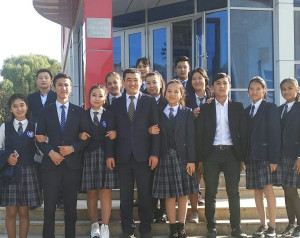

– You are currently working as a lecturer and program coordinator at the Institute of History and Law. Was it difficult to transition from management work to pedagogical activity?
– There is a difference between school and higher education. In school, the main activity is teaching and upbringing. The subject knowledge and pedagogical skills of teachers in Bilim, Kara-Suu were excellent. There were colleagues as a teacher who inspired admiration. They work creatively and with dedication. At the lyceum and gymnasium, I was more involved in organizational work than in teaching. In higher education, the focus is on knowledge and science. After moving to the faculty, I have been trying to conduct good lessons and develop science and knowledge. This also has its own difficulties and challenges.
– Your scientific research mainly focuses on 19th-century socio-political life. What motivated you to choose this period?
– Essentially, my scientific advisor, Professor Zheenbek Alymbaev, guided me in choosing this direction. He asked, “What topic do you want to research?” I mentioned a few topics. Then he said, “When choosing a research topic, it is not just to defend a dissertation, but it is important to select a broad scientific issue that is highly relevant in Kyrgyz historiography. Even after defending your dissertation, you should continue your research and become an expert on that period.” Later, I chose this direction.
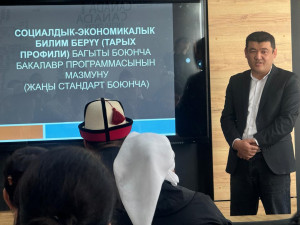

– Are you currently working with documents from the Tashkent archives? What new information have they brought to your research?
– Archival materials are considered unpublished sources. In my research, I tried to introduce previously unpublished archival documents into the scientific discourse concerning the subdivision of the southern Kyrgyz into clans, when and how these clans were formed, clan leaders, biys, qazis, their structures, functions, elections held for them, and instances of corruption during those elections.
– While working in the archives, were there moments when you felt, “Here is a living proof of history”?
– When studying archival materials, you don’t always find exactly what you are looking for. In the Tashkent archives, according to the rules, only seven files are provided per day. If the requested files contain no relevant information, you have to wait for the next day. Sometimes, you have to spend an extra day just waiting elsewhere. Meals, dormitory, time — everything takes planning. You have to accept these conditions and study continuously without wasting a single minute because you are allowed only three hours before lunch and three hours after. Phones are taken away, and photographing is forbidden. You work with notebooks and pens. It requires extreme patience. If you need to copy the necessary pages from a file, each page costs 400 soms if you pay for it yourself. For visitors from other countries, the fee is higher. However, the pleasure of working in the archives is immense for historians. When you encounter unknown, disputed, or ongoing research issues, you feel a thrill and, as they say in Russian, “adrenaline.” It makes you eager to dig into the archives again.

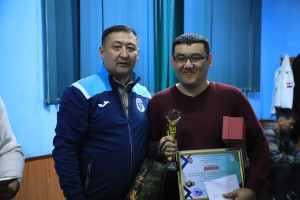
– What advice would you give to today’s youth, especially those choosing the path of science?
– I would remind them of the saying, “Everything begins with intention,” and advise them to set their intentions clearly and pursue science with the right goals. If they do so, I believe God will guide them to achieve those intentions. The ultimate goal of all scientific activities should be pure, conscientious before the public, and, most importantly, beneficial to society and the state. But this is not easy. Therefore, I would advise them to work hard and act with sincerity.
– What are your plans in your scientific and pedagogical work, and in your personal life?
– In my pedagogical work, I wish that the knowledge I impart to students is deep and inspiring. To achieve that, it must first exist within oneself. Therefore, I continue to strive and deepen my knowledge along the path of science. In my personal life, I try to act in accordance with the path of God: being kind to parents, devoted to siblings, caring toward my spouse and children, and fair with friends. However, sometimes the pressures of life do not allow for such ideal behavior.
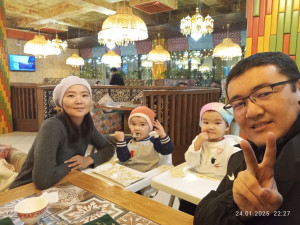
Interviewed by Zinagul Nuralieva

Main Campus of OshSU, 331 Alymbek datka Street, Osh City, Kyrgyzstan. General Division: +996 3222 7-07-12, fax: +996 3222 7-09-15, edu@oshsu.kg
OshSU Admissions Committee: +996 3222 7-08-18, priem@oshsu.kgColleges
- International Education Programs
- Medical College
- Finance and Law
- Uzgen International Medicine
- STEM Innovation
- Industrial and Pedagogical
- College of Agriculture
- Construction College
Schools
- "Arashan" Humanitarian School
- Institute of Oriental Studies
- Institute of Mathematics, Physics, Engineering and Information Technologies
- Institute of Economy, Business and Management
- Institute of Philology and Intercultural Communication
- Institute of History and Law
- Institute of Pedagogy, Art and Journalism
- Institute of Natural Sciences, Physical Education, Tourism and Agrarian Technologies
- Institute of Nanotechnology and Artificial Intelligence
Lyceums and gymnasiums
Offices
- Administrative- household supporting office
- Business Park at Osh State University
- International Relations Department
- Department of Academic Affairs and Strategic Planning for Educational Policy Development
Centers
- Cultural and Aesthetic Center named after R. Adikadyrov
- Foundation of R.Abdykadyrov
- Public Relations Center
- Internship and Career Center
- OshSU Center for Qualification Improvement
- Next Generation Hub Center
- Congress Resort OshSu Center
- Natural Resources Center
- Mountain Ecosystem Protection and Green Innovations Consulting Center
- Center for Scientific Research and Innovation